How scoring works
What the 0-100 quality score measures, how the A-D grade is derived, and where to read the breakdown for one lead.
Unless scoring is turned off for your organization, every lead gets a 0-100 quality score on arrival, built from three independent axes, and a letter grade derived from the total. The score is a snapshot: a lead is scored once and never re-scored.
| Axis | Points | What it measures |
|---|---|---|
| Contact validity | 40 | Whether you can actually reach this person — email (25) and phone (15) |
| Data completeness | 30 | How much of what your pipeline asks for the lead actually carries |
| Authenticity | 30 | Whether the lead reads as a genuine person with genuine intent |
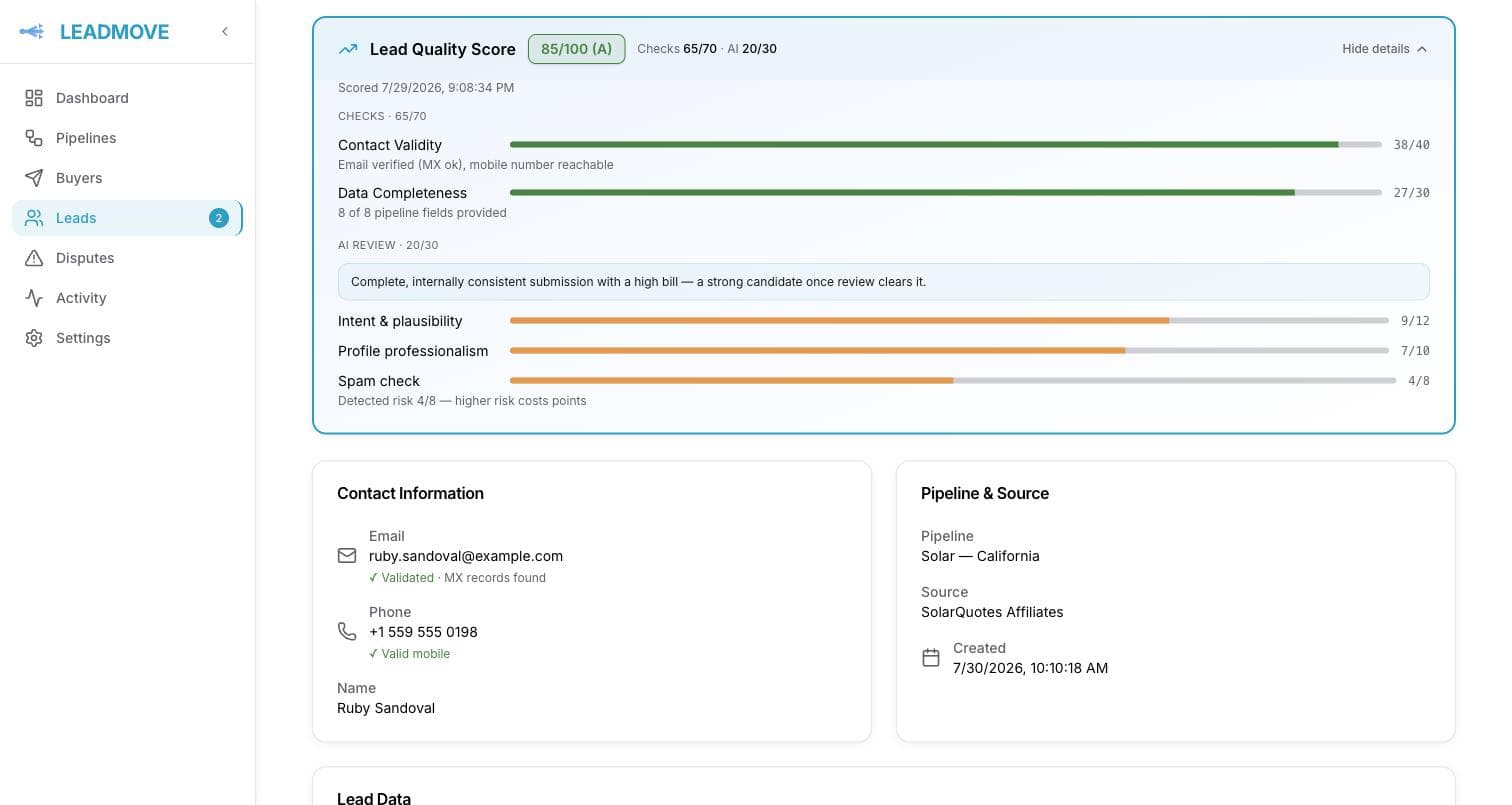
On the lead page, the first two axes appear together under Checks (up to 70 points), and authenticity under AI review (up to 30) with three sub-scores — Intent & plausibility, Profile professionalism and a Spam check where detected risk costs points — plus the reviewer's written verdict.
Contact validity — 40
The email is checked for syntax, for a disposable-inbox domain, and for whether the domain can receive mail at all. All three have to pass for full marks: a perfectly formed address on a domain with no mail server is unreachable and scores like a throwaway inbox.
The phone is checked for validity in the lead's country, and separately for numbers that parse fine but were never meant to be dialed — repeated or sequential digits. A phone you can only call "maybe" earns partial credit; a plainly fake one earns almost none. A contact field that couldn't be verified at all earns partial credit, never full.
Data completeness — 30
Measured only against the fields your pipeline collects. Fields you marked required count double. A lead that fills a short pipeline schema scores full marks; fields your pipeline never asks for are never held against it. The breakdown names the missing ones.
Authenticity — 30
An AI reviewer reads the lead and rates plausibility of intent, consistency of the name and contact details, and spam/fake risk, then leaves a short written verdict you can read on the lead. Built-in checks for obvious junk (placeholder names, throwaway text) subtract points on top, and are listed as red chips.
If the AI reviewer is unavailable
The lead is still scored. Authenticity falls back to a neutral middle value so grades don't shift during an outage, the deterministic checks and the built-in junk checks still apply in full, and the breakdown carries an AI fallback used badge so you know why there's no written verdict.
Grades
| Grade | Score | Meaning |
|---|---|---|
| A | 80-100 | Top quality |
| B | 60-79 | Good |
| C | 40-59 | Fair |
| D | 0-39 | Poor |
Where to read it
The grade badge is on the leads list and on the lead itself. Open a lead for the full breakdown: a bar per axis with its points and a plain-language reason ("Email domain doesn't exist (no MX records)", "3/5 pipeline fields filled (missing: zip, timeframe)"), the AI verdict, its sub-scores, and any penalty chips.
Turning scoring off
Scoring is on by default. An owner or admin can turn it off for the whole organization in Settings › General › AI features.
With it off:
- No lead data reaches an AI model.
- New leads carry no score and no grade. Leads scored before you switched it off keep theirs.
qualityScoreandqualityGradeleave the condition builders, the price rules, the merge-code pickers, the leads-list filter and the Quality column.- Email and phone validation keeps running — those are local checks, not AI, and you still see them on each lead.
You cannot turn it off while an active routing rule or a buyer's price rules still read the score or grade: the card lists what to change first, with a link to each one. Remove those conditions, then switch it off.
Turning it back on scores the leads that arrive from then on. Leads that came in while it was off are never scored retroactively — same snapshot rule as everywhere else.
Common questions
Can I change the weights or the grade thresholds? No. The scale is the same for every account, which is what makes an "A lead" mean the same thing to you and to your buyers.
Why did the same person score differently in two pipelines? Data completeness is measured against each pipeline's own fields. A lead that fills a 4-field pipeline scores full marks there and can lose points in a 9-field one.
A lead has a valid email and phone but only scores in the 50s. Contact validity is 40 of 100. The other 60 come from completeness and authenticity — a sparse lead, or one that reads as low-intent, lands mid-range even with perfect contact details.
Which leads get scored? Leads that arrive clean. Spam, invalid and duplicate leads are stored but never scored — they were never going to a buyer. A lead held for manual review is scored, on purpose, so you see its grade before you approve it.